Is your business showing up in Google's AI Overviews?
Google's AI now answers many local searches before anyone sees a link. Here's what gets your business cited, based on the latest research.
Is your business showing up in Google's AI Overviews?
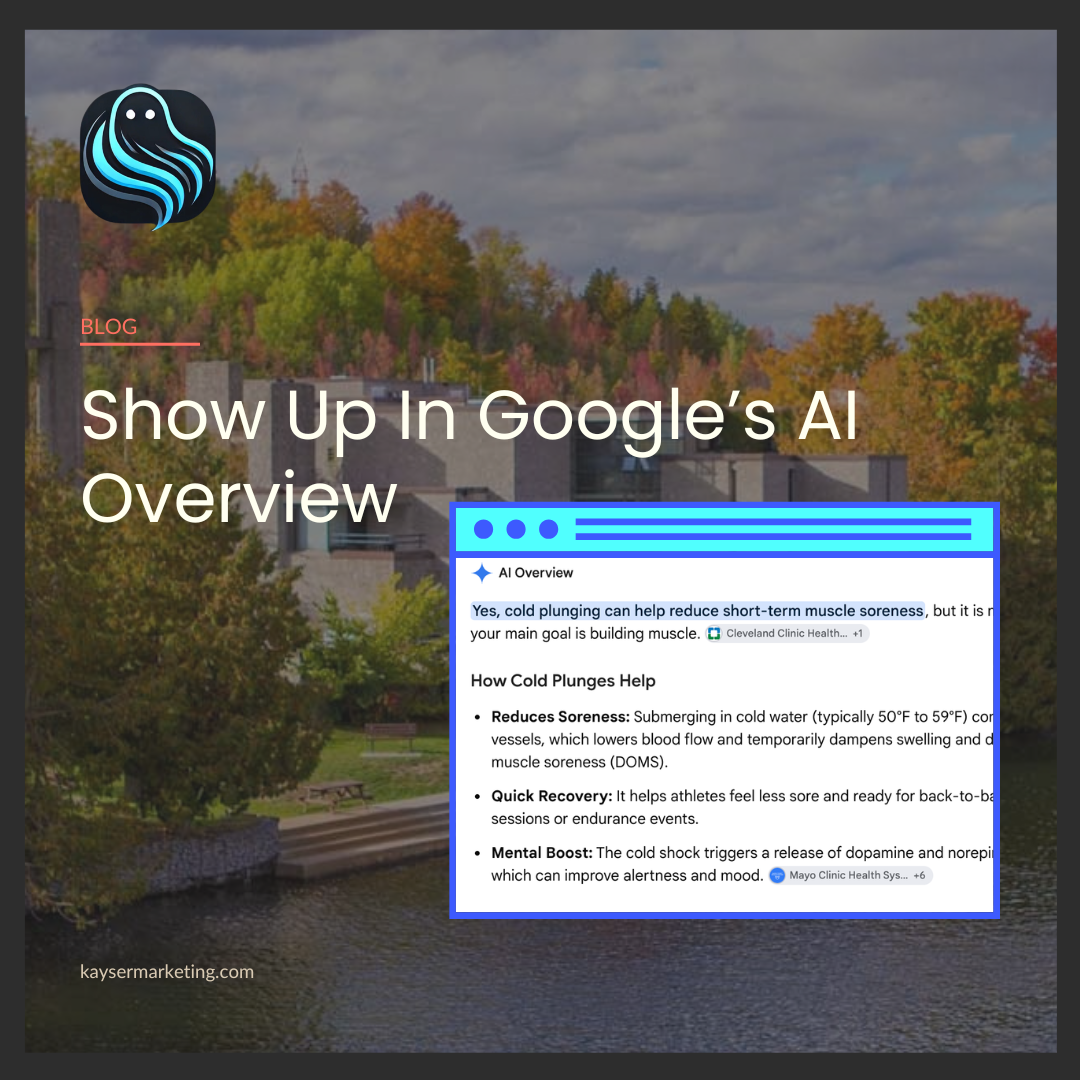
Search "is cold plunging good for sore muscles" on Google and you probably won't see a list of blue links first. You'll see a paragraph written by Google's AI, with a handful of sources tucked beside it.
That's an AI Overview. For a growing share of searches, it's the first thing your customers read (and you probably read as well).
The question for a local business is simple: when Google writes that answer, is your name in it?
The good news is that getting there isn't a whole new discipline. It's mostly solid local SEO, with one shift in emphasis: Google's AI cares more about where you're mentioned than about who links to you.
Here's what the research and experience with my clients shows has the biggest impact.
First, know when AI Overviews show up
Not every search triggers one. Local Falcon tracked 60,000 local business searches and found AI Overviews on about 40% of them.
The split is what matters:
- "Why" and "how" questions: about 58 to 60%
- Searches to hire or buy ("massage therapist near me"): about 17%
- Searches for a specific business by name: about 10%
Adding a city name to the search made an AI Overview less likely, too.
In plain terms: when someone is ready to buy, Google still mostly shows the map and the three businesses in it (check out the post I did on the Map Pack for ranking there). When someone is still figuring things out, Google answers with AI.
You still want to win both. Your Google Business Profile wins the buyer searches. Helpful content and mentions around the web win the research searches.
As you'll see, your Business Profile carries a lot of weight in both.
1. Your Google Business Profile does most of the heavy lifting
BrightLocal analysed nearly 2 million citations from AI search tools for local businesses. In Google's AI Overviews, about 67% of those citations pointed to a Google Business Profile. Yelp was a distant second at under 8%.
So if your profile is half-finished, that's the first fix you can make:
- Categories. Choose the most accurate primary category, then add every secondary category that genuinely fits.
- Services. List every service you offer, each with a short, plain-language description. This is text Google can quote.
- Hours and service area. Accurate, including holiday hours. Wrong hours are the fastest way to lose trust with Google and with customers.
- Photos and posts. Recent, real and regular. A profile that hasn't been touched in two years looks closed and Google will start to treat it that way as much as potential clients do.
- Reviews. Keep a steady flow coming, and ask customers to mention what they came in for. "Great deep tissue massage, finally fixed my lower back" tells Google exactly what you're good at. "Great service!" doesn't.
None of this costs money to do yourself in an hour or two. All of it compounds for your business.
2. Mentions are the new backlinks
For years, SEO was about getting other websites to link to you. For AI search, being talked about matters more, link or not.
Whitespark surveys leading local SEO experts every year on what drives local rankings. In its latest report, three of the top five factors for AI search visibility were citation factors: these are places your business is listed or mentioned. As one contributor put it, "In AI SEO, mentions (citations) are the new link."
What that looks like for a local business:
- Core listings, consistent everywhere. Yelp, Facebook, Apple Maps, Bing and the directories that matter in your industry. Same name, address and phone number on every one.
- "Best of" lists. Local roundups like "best spas in Peterborough" or "top-rated chiropractors in the Kawarthas." AI tools read these to decide who's worth recommending. Ask to be included. It works more often than you'd think.
- Local press and partnerships. A mention in a local news story, a community event page or a partner's website all count.
- Social chatter. Customers tagging you and talking about specific services helps Google connect your name with those services.
3. Make your website easy to quote
AI Overviews pull short, clear answers. If your website buries the answer in a wall of text, Google will quote someone else.
In the same Whitespark survey, scannable structure (clear headings, bullet points, short paragraphs) ranked as the most important website factor for AI visibility. Close behind you'll find: a sensible site structure, fresh content, FAQs on service pages, and schema markup.
The practical checklist:
- One page per service. Not one "Services" page listing eight things. Each service gets its own page explaining what it is, who it's for and what it costs (or a price range).
- An FAQ section on every service page. Answer the questions customers actually ask you on the phone: "How long does a session take?" "Is it covered by my benefits?" Put the answer in the first sentence, then add detail. Most businesses don't cover the FAQs and it's a quick-win you can add that shows your expertise to clients and helps you show up for Google.
- Schema markup. Behind-the-scenes code that tells Google, in its own language, that you're a local business, which services you offer and which questions you answer. Customers never see this, but Google does.
- A reviews page in your main menu. Make social proof easy to find for people and for AI.
- Keep it fresh. Update pages when prices, services or hours change. Stale sites lose ground for SEO and AI visibility.
A quick word on ChatGPT
Google isn't the only AI people ask for recommendations, and ChatGPT works very differently. In the BrightLocal study, Yelp made up about 61% of ChatGPT's local citations, while Google Business Profiles barely appeared.
Yelp gets far less use in Canada than in the US, so many local owners ignore it. If you want to show up when someone asks ChatGPT for a recommendation, a claimed, complete Yelp listing with real reviews is cheap insurance.
What to do this week
You don't need a new strategy. Just make sure these basics are done properly.
Three steps to do:
- Audit your Google Business Profile. Every service listed and described, categories checked, photos current. Then send a review request to your last ten happy customers.
- Claim your top five listings. Yelp, Facebook, Apple Maps, Bing and your industry's main directory. Make the name, address and phone number match exactly.
- Add an FAQ to your most valuable service page. Five real questions, each answered directly in the first sentence.
Do those three and you'll be ahead of most of your competitors, in AI Overviews and in regular search.
Want a second set of eyes?
Not sure where your business stands? Book a free digital marketing audit. I'll look at your Google Business Profile, your listings and your website, then tell you which fixes matter most for your business. No jargon, no hard sell.
Sources